
Newsfluencers by Anmol Irfan
May 14, 2025When Reality is Manufactured: AI Misinformation and the Future of Journalism in Pakistan by Saddia Mazhar
May 14, 2025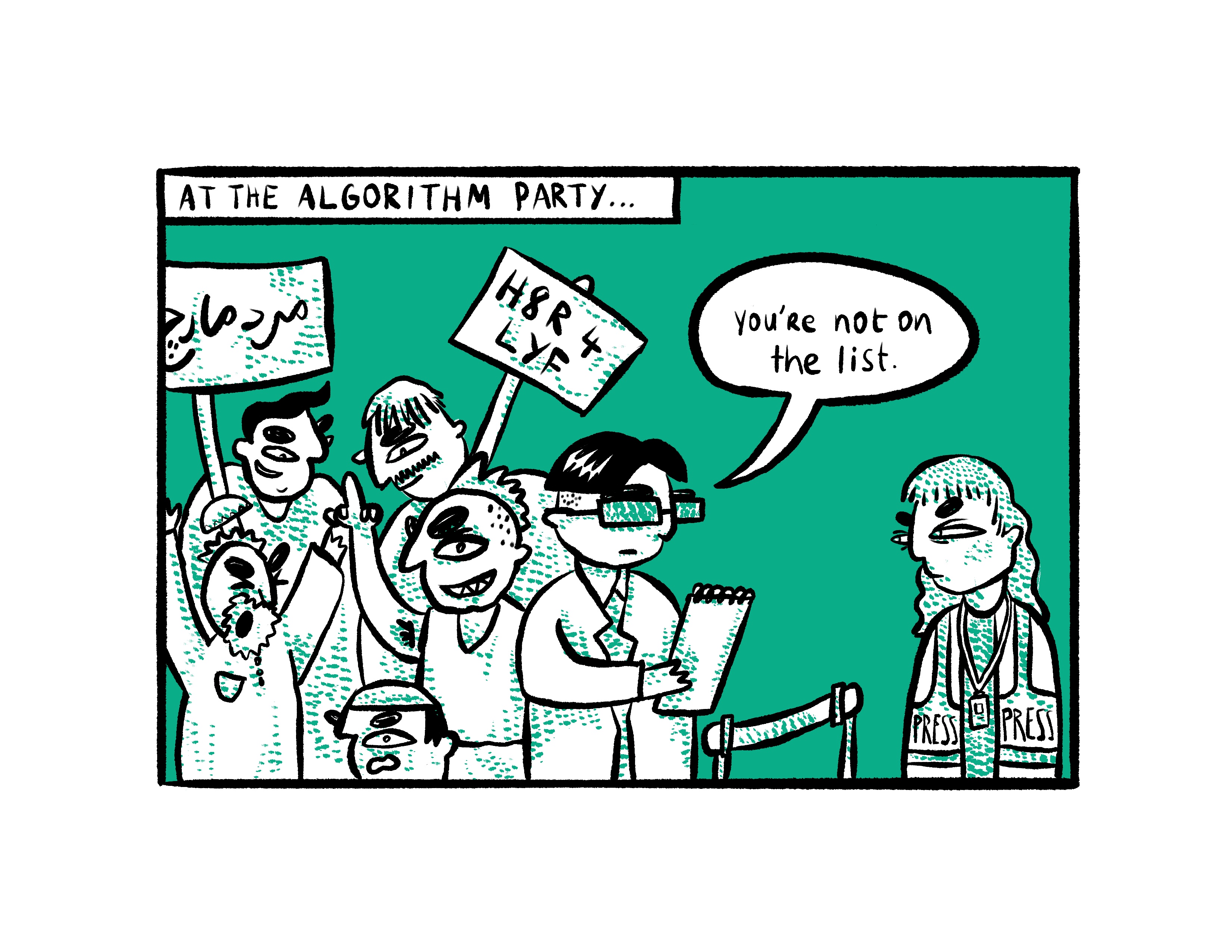
Growing up in Gujrat, I often heard stories about chupaal — the traditional village gathering where community members would sit together, under a tree or in a courtyard, to discuss their collective problems and ideas. It was a space where every voice mattered, where dialogue, not domination, shaped decisions.
That spirit stayed with me.
When I looked around at the civic landscape available to young women like me, I saw a painful gap. Public spaces were shrinking, and digital spaces often felt no safer. So, along with a group of like-minded girls, I envisioned Chupaal — not as a physical place, but also a digital safe space where women could gather, share stories, talk about democracy, civic engagement, gender rights, and social justice.
In the beginning, our dream took flight. We organized webinars, storytelling circles, online civic dialogues — spaces where young women from different parts of Pakistan, many stepping into public discourse for the first time, felt seen and heard. We talked about leadership, climate justice, electoral rights, mental health, and the daily struggles of being a woman trying to participate in civic life.
It wasn’t just about talking. It was about reclaiming.
But slowly, the very platforms that hosted our efforts began to turn against us. Posts that addressed “sensitive” issues like gender rights, democratic participation, war conflicts or environmental activism were quietly pushed down. My Facebook account restricted and reach declined without further explanation. Others disappeared into the vast sea of content no one ever saw.
I felt the weight of it — the silent shrinking of a space we had worked so hard to create.
We were not competing with celebrity gossip, clickbait outrage, or viral dance trends. Our mission was slower, deeper: building civic literacy, amplifying marginalized voices, fostering collective empowerment. But the algorithms didn’t reward that. They punished it even after years of hard work.
It’s a cruel irony. In Pakistan women’s physical presence in public spaces is already contested and often unsafe, even the virtual spaces we carve out for ourselves face erasure — hidden behind the cold, opaque logic of algorithms.
In the rugged terrains of Mianwali, MahaPara — a young journalist and activist — fights a double battle: against deep-seated cultural barriers and the hidden biases of digital algorithms.
As a woman reporting on women’s education, tribal land rights, and honor killings, MahaPara constantly challenges social norms.
“When I started posting about girls being pulled out of school at age twelve, I was warned by my own relatives,” she said. “They said, ‘Tumhara kaam nahi hai bolna’ (It’s not your place to speak).”
Cultural restrictions meant she often had to report under pseudonyms, or post through male colleagues’ accounts. But even when she found a way to publish her work digitally, MahaPara faced another, invisible barrier: algorithmic suppression.
“Because my stories don’t use fancy graphics or English buzzwords, they don’t spread,” she explained. “Stories from cities get millions of likes, but real stories from our villages remain unseen.”
In a country where journalism has long operated under the shadow of censorship and societal pressures, a quieter yet equally insidious threat has emerged: the digital suppression of marginalized voices. Beyond arrests, intimidation, and broadcast bans, a new frontier of silencing is unfolding—one dominated by invisible algorithms, obscure moderation policies, and hostile online environments.
Today, critical stories exposing gender-based violence, climate injustice, land dispossession, and political corruption often disappear before they even reach audiences. They are flagged, downranked, or buried by social media algorithms unequipped to understand the country’s complex realities. This silent battle is redefining press freedom, reshaping who gets to tell Pakistan’s stories—and who is erased.
Through the experiences of grassroots activists, women journalists, and local movements across rural areas of Punjab and Balochistan, this article examines the digital barriers threatening democracy, the survival tactics marginalized groups are forced to adopt, and the urgent reforms needed to reclaim digital spaces for all.
Algorithmic Bias: The New Censor
When Facebook, Instagram, TikTok, and YouTube burst onto the global scene, they promised to democratize information. For many in Pakistan, particularly those marginalized by traditional media, these platforms initially offered hope: a direct, uncensored line to audiences both local and international.
But hope quickly collided with reality.
These platforms, largely designed for Western contexts, use automated moderation systems to regulate content. Machine learning algorithms are tasked with identifying “graphic content,” “hate speech,” or “misinformation.” Yet, they often lack the cultural nuance to differentiate between harmful material and legitimate journalism exposing brutal realities. Algorithms are like secret codes that decide what you see on your social media feed. They are automatic systems designed to show you content you might like.
Digital Barriers in Rural Pakistan:
In regions like South Punjab and Narowal, Balochistan internet access is unstable, slow, and expensive. According to the Pakistan Telecommunication Authority (PTA) Annual Report 2023, as of 2023, only 36% of rural populations have access to mobile broadband compared to 62% in urban areas.
Lack of digital literacy further worsens the problem. Many people in villages are unaware of how social media platforms prioritize content, how algorithms work, or even how to protect their accounts from being flagged or taken down. Without digital education and strong infrastructure, rural voices are left shouting into a void.
And even when community campaigns are launched — like those advocating for climate resilience among farmers or women’s education — they rarely reach the audience they deserve. Algorithms prioritize viral entertainment, not grassroots activism. As a result, these efforts get buried and lost, weakening the momentum needed for real change.
Posts are removed without human review; accounts are suspended; visibility plummets. As a result, critical, life-saving narratives vanish—sometimes permanently.
Balochistan, a region marred by decades of conflict, poor governance, and systemic discrimination, the voices of local activists and researchers are often stifled — not just by state mechanisms but also by digital algorithms. Shazia Batool, an MPhil student in International Relations and a research assistant from Quetta, represents a generation of educated Hazaras striving to tell their community’s story. Yet, despite her efforts, she finds her work marginalized online. The algorithmic focus on virality and engagement sidelines complex stories from marginalized regions like Balochistan, especially when they challenge powerful narratives or expose uncomfortable truths.
Additionally, sensitive topics like enforced disappearances, ethnic violence, or state-led injustices often trigger content moderation systems. Shazia and others sometimes face shadowbanning — their posts are limited in reach without clear notification — simply because they use certain keywords (e.g., “genocide,” “disappearances,” “Balochistan struggle”) flagged by platform moderation systems. This invisible censorship silences dissenting voices without leaving clear evidence.
The Human Cost of Digital Harassment:
Beyond algorithmic bias, another brutal force shrinks digital spaces for marginalized voices: harassment.
According to a Digital Rights Foundation report, around 72% of female journalists in Pakistan have experienced online harassment. For women journalists in Pakistan’s conservative society, online abuse is not random—it’s systematic. Honor and shame, deeply rooted cultural constructs, are weaponized against women who dare to speak publicly. Threats, doxxing, revenge porn, and slurs flood their timelines. The message is clear: stay silent, or suffer.
Simal Fatimah, a journalist from Mandi Bahauddin, outlines the coping mechanisms many women have adopted:
“Several aspiring female journalists I know have created accounts under fake names, avoid posting profile pictures, and keep their accounts private just to protect themselves.”
Yet privacy comes at a cost. Social media platforms deprioritize content from private or restricted profiles. Posts from such accounts receive fewer interactions, drastically limiting reach. The very act of hiding to stay safe—essential for survival—shrinks a journalist’s audience and influence.
Moreover, the psychological toll is profound. Simal shares how colleagues silently battle anxiety, depression, and isolation. The constant barrage of threats doesn’t just push individuals offline; it reshapes entire digital landscapes, making them more male-dominated, conformist, and hostile to dissent.
Visibility is a double-edged sword. For women journalists, choosing between professional advancement and personal safety often means abandoning dreams altogether.
Eisha, a reporter from Gujrat, embodies this painful calculus. She turned down offers to work as an on-screen anchor—not due to a lack of ambition, but out of fear.
“I wanted to tell human rights stories,” she said. “But I have a family to think about. Sometimes, it’s just not worth the risk.”
How Harassers Game the System by Weaponizing Algorithms:
When brave journalists do persist in speaking out, they face sophisticated forms of attack. Mass reporting has become a key tactic.
Ramna Saeed, a journalist from Gujranwala, has long focused on reporting the struggles of women and minorities. Her courageous work has drawn waves of online abuse — but also orchestrated attempts to silence her using platform tools.
“It wasn’t just criticism of my journalism,” Ramna shared. “They attacked my appearance, my character — just because I was a woman daring to speak.”
Beyond direct harassment, Ramna’s harassers organized mass-reporting campaigns, falsely flagging her posts as hate speech or misinformation. These mass flags triggered platform moderation systems, leading to temporary content removals, account restrictions, and shadowbanning.
“There were days I wanted to give up,” Ramna admitted. “But I knew if I stayed silent, no one would tell the stories of the women who trusted me with their voices.”
Here, harassment weaponizes algorithmic vulnerabilities. Tech platforms, relying heavily on automated enforcement, often act on the volume of reports rather than the accuracy of claims — a flaw that malicious actors exploit with devastating effect.
The Forgotten South with Regional Disparities:
The digital marginalization extends beyond gender. In Pakistan’s rural and underserved regions — like South Punjab, Balochistan, and interior Sindh — journalists face even greater algorithmic disadvantages.
Content produced in Urdu, Punjabi, Saraiki, Sindhi, and Balochi often receives less algorithmic prioritization than content in English. Local activists struggle to reach national audiences, let alone global ones, as platform algorithms favor high-traffic, metropolitan, English-language accounts.
The disconnect between content moderation standards and local realities means that vital stories — about environmental degradation in Kohlu, or forced evictions in Rahim Yar Khan — are treated as “low-priority” or “borderline content” by digital platforms.
By muting these regional narratives, tech platforms unintentionally reproduce the same urban-centric, elite-dominated media ecosystem that activists have long fought to challenge.
How the Algorithms Marginalize Grassroots Movements:
The consequences of digital suppression ripple far beyond individuals. Entire movements, communities, and regions are rendered invisible. Grassroots initiatives fighting for climate resilience, gender rights, and democratic participation find themselves trapped in a digital loop: create meaningful content, only to see it buried by algorithmic indifference.
The Ecoist Campaign in Dera Ghazi Khan, founded by Basham Zen and led by a coalition of local environmentalists, works tirelessly to restore degraded lands, revive indigenous farming techniques in Southern Punjab. Their work is critical, especially as climate change increasingly devastates rural livelihoods and displaces vulnerable communities.
Beyond land restoration, Zen has a deeper mission: to amplify the stories of marginalized groups living along the banks of the Sindhu (Indus) River—communities who face not only environmental injustice but cultural and economic erasure.
Yet despite their tangible on-ground achievements, community-led innovations- the Ecoist’s social media campaigns remain largely unseen.
“We document our work every day,” said Basham Zen. “But without money to boost posts or create viral content, and without fitting the algorithm’s taste for sensationalism, both our environmental efforts and the voices of Sindhu’s marginalized communities are buried.”
In an era where environmental crises and cultural losses demand urgent attention, the silencing of initiatives like Ecoist is a tragedy with far-reaching consequences.
Saba Choudhry, a journalist from Narowal, has long understood what it means to be invisible.
Growing up surrounded by fields, narrow village roads, and vibrant yet overlooked communities, she witnessed a Pakistan that mainstream media rarely bothered to portray — a Pakistan full of resilience, ingenuity, and quiet dreams. Yet when rural life did appear in national narratives, it was often reduced to tired stereotypes: tales of backwardness, poverty, or tragedy.
Determined to challenge these perceptions, Saba founded Rural Lens — a digital platform dedicated to telling authentic stories from the margins. Her vision was simple yet radical: to document the lived realities of rural communities through raw, heartfelt narratives that honored their complexity.
Through Rural Lens, she shared stories of women revolutionizing agriculture, of young entrepreneurs battling economic odds, and of entire communities responding to climate challenges with innovation and grit. Her storytelling was personal, unpolished, and deeply human — precisely the kind of journalism that rarely finds space in sensationalist media landscapes.
However, Saba’s work faced an uphill battle. Unlike the glossy, high-budget content designed to go viral, it focuses on nuance and authenticity — while its greatest strength — became its biggest hurdle in a digital world driven by algorithms that prioritize entertainment, outrage, and celebrity news. Posts that took days of labor to create were often buried under an avalanche of trending memes and political controversies.
Rural Lens remained confined to niche audiences, its reach limited despite the universal importance of its stories.
Local Narratives Trapped in Digital Silos:
The experiences of Ecoist, Chupaal, and Rural Lens reveal a systemic failure. Social media promised to democratize storytelling. Instead, it created vast echo chambers where only commercially profitable, politically convenient, or entertainment-driven narratives thrive.
Grassroots campaigns lack the resources to “boost” posts, pay for ad placements, or manipulate engagement algorithms. Consequently, their stories remain siloed, speaking only to the already-converted, unable to influence national or international conversations where real change could be sparked.
Meanwhile, the national discourse continues to be dominated by urban, elite-centric perspectives—leaving out the very communities most affected by environmental degradation, political oppression, and gender inequality.
When local narratives are buried, the consequences are dire:
- Environmental crises continue unchecked because frontline communities cannot amplify their realities.
- Women’s political participation remains stunted because platforms like Chupaal cannot achieve critical mass.
- Rural innovation and entrepreneurship remain disconnected from support networks because platforms like Rural Lens cannot gain visibility.
- Silencing these voices through algorithmic gatekeeping doesn’t just harm individuals. It reinforces structural inequalities, ensuring that the rich grow richer, the powerful more powerful, and the marginalized more invisible.
Reclaiming Digital Spaces:
It would be simplistic to condemn social media platforms entirely. For countless marginalized individuals in Pakistan—rural women, grassroots activists, young citizen journalists—they remain the only megaphone available. Yet realizing their transformative potential demands targeted, systemic changes to ensure these spaces genuinely serve those who rely on them.
Rather than relying on generic global initiatives, social media companies must establish south asia-specific funds and partnerships with local journalism networks, women’s organizations, and rural storytellers. Recognizing their influence on public discourse, platforms must form advisory boards from Pakistan. Content moderation decisions should not be made remotely, detached from the socio-political context of the country. Ethical platform governance demands meaningful civil society oversight.
Algorithms cannot grasp the nuances of satire, activism, or dissent rooted in diverse cultures. Companies must invest in hiring and training local moderators fluent in multiple languages. Partnerships with human rights organizations can help ensure critical journalism and advocacy are protected, not wrongly flagged or erased.
At the national level, Pakistan must urgently reform digital safety laws to better protect journalists and marginalized groups from online harassment. Laws like the Prevention of Electronic Crimes Act (PECA) must be reshaped to safeguard free expression rather than suppress it. Swift reporting mechanisms and specialized, gender-sensitive cybercrime units are essential. Establishing legal aid centers for digital rights at the district level would further ensure rural journalists and activists have access to justice.
Community organizations should conduct digital literacy workshops, particularly for women and rural youth, equipping them to navigate online spaces safely. Independent media outlets can amplify underrepresented voices, challenging dominant narratives. By supporting grassroots digital initiatives, advocating for stronger protections, and standing against censorship and harassment, locals can help transform social media into a more equitable and empowering tool for all.
Conclusion:
The battle for free expression in Pakistan is no longer fought only against state censorship or cultural taboos. It is now also waged against invisible algorithms, biased content moderation, and weaponized digital harassment.
For grassroots activists, women journalists, and rural storytellers, the stakes could not be higher. Their erasure from online spaces silences critical voices necessary for Pakistan’s democratic, environmental, and social progress.
When our Chupaal gatherings were shadowbanned, we adapted. We shifted to WhatsApp and Signal encrypted groups. When webinars lost visibility, we organized offline study circles in village schools, colleges and women’s centers. We created storytelling campaigns that used community radio, poetry pamphlets, and art instead of depending solely on traditional social media posts. We built micro-communities—small circles of trust—especially among women in rural areas.
I remind myself often: we are not asking for favors. We are demanding the basic right to participate, to organize, and to imagine a future where our voices are not algorithmically erased but amplified.
The question facing Pakistan—and indeed the world—is urgent:
Whose voices are we willing to hear?
And whose are we willing to let vanish into digital oblivion?
